

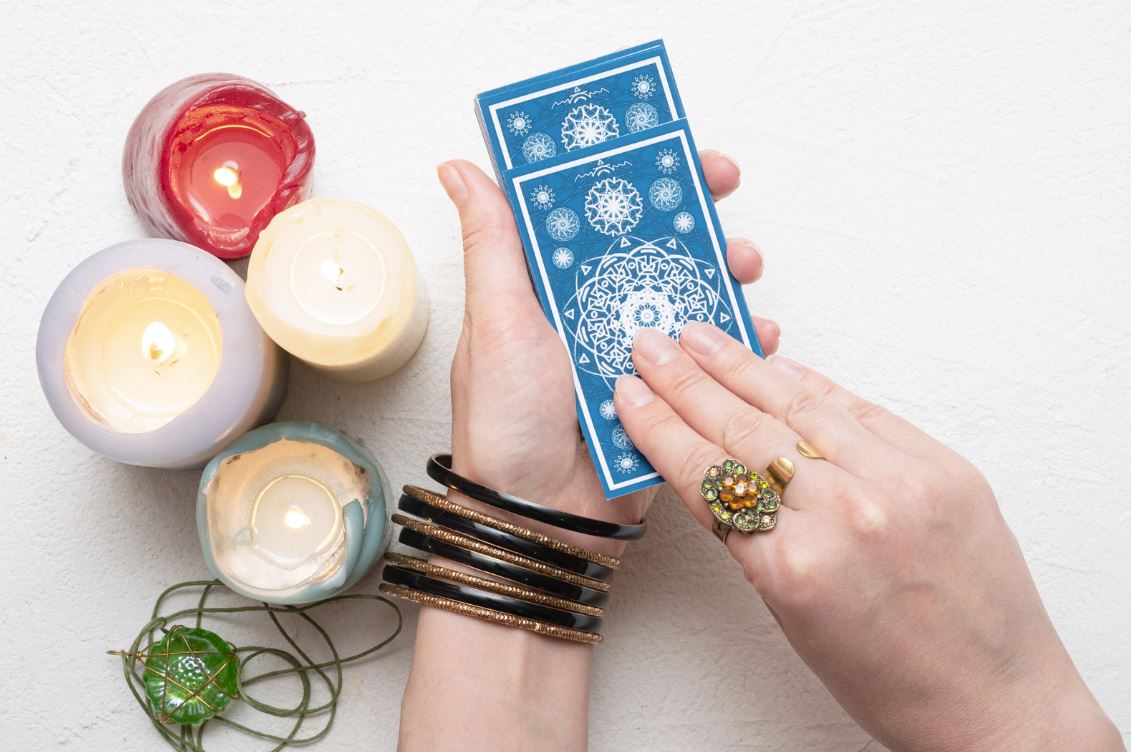
You can read your own tarot cards as an optional reflection activity. There is no general rule that a deck must be gifted, that most psychics forbid self-reading or that practising on yourself makes reading for others harder.
Use cards as prompts for thinking, not as verified information about another person’s thoughts, a health condition or a future event.
Start with the deck you actually have
The familiar Rider–Waite deck has 78 cards. Other products may have different structures or additional cards. Oracle decks are not necessarily organised like tarot.
Read your deck’s guidebook and notice the images. Learning established meanings and exploring your own associations can coexist; you do not have to reject the guidebook to be intuitive.
Choose a question about your own choices
Try “What should I consider about this decision?” rather than “What will certainly happen?” Avoid asking a card to diagnose symptoms, prove a partner is unfaithful or decide a financial risk.
Write the question down before drawing. That can help you notice when you reshape it to fit an answer you wanted.
Try a one-card reflection
- Shuffle in a way comfortable for you and draw one card.
- Describe what you see before interpreting it.
- Read the relevant guidebook entry and consider a possible connection to your question.
- Write one alternative interpretation.
- Choose a practical next step and identify what still needs checking.
You do not need to draw repeatedly until you receive a reassuring card. Decide a stopping point so the exercise does not become a search for certainty.
Personal bias is possible, not a prohibition
When you care deeply about an outcome, it can be easy to favour an interpretation that supports it. A friend can offer another perspective, but their reading is not automatically objective or accurate either.
Compare the interpretation with known facts. If a reading contradicts clear boundaries, safety information or professional advice, do not treat the cards as a reason to ignore those sources.
Keep consent and privacy in view
Do not claim to know someone’s secret feelings from a card. When reading for another person, ask whether they want to participate and let them decline. Keep sensitive details private.
For another self-reflection method, see our grounded five-step guide. A useful reading helps organise a question; it does not need a promise of supernatural knowledge.
I appreciate the article’s clarification that nothing bad will happen if you read your own cards. This helps to demystify some of the misconceptions around tarot reading.
The point about avoiding self-bias when reading your own cards is a critical one. It’s fascinating how our biases can influence our interpretations, making it harder to offer objective readings.
The article presents a balanced view on the complexities and nuances of tarot reading. The suggestion that beginners might find it challenging to understand the detailed symbols on the cards is quite practical.
Indeed, understanding the intricate symbolism in each card can be daunting for beginners, but with consistent practice, it becomes more intuitive.
I agree. Starting with guided readings from experienced tarot readers can also help novices ease into the practice.
The advice on not memorizing the instructions but instead focusing on personal interpretation of the cards is quite insightful. It emphasizes the subjective nature of tarot readings.
This article provides a practical guide for those new to tarot reading. The emphasis on asking open-ended questions and involving a trusted friend can really help beginners develop their skills.