


Free psychic reading offers can mean complimentary minutes, a promotional credit or a discounted package—not an entirely free appointment. Before entering payment details, find out when billing starts, the regular rate and how to stop. A welcoming conversation does not make unclear charges acceptable.
A short introduction can help you decide whether a reader’s style feels comfortable and relevant. You can value the spiritual conversation while checking the payment terms just as carefully. The prices below are hypothetical examples to help with that calculation.
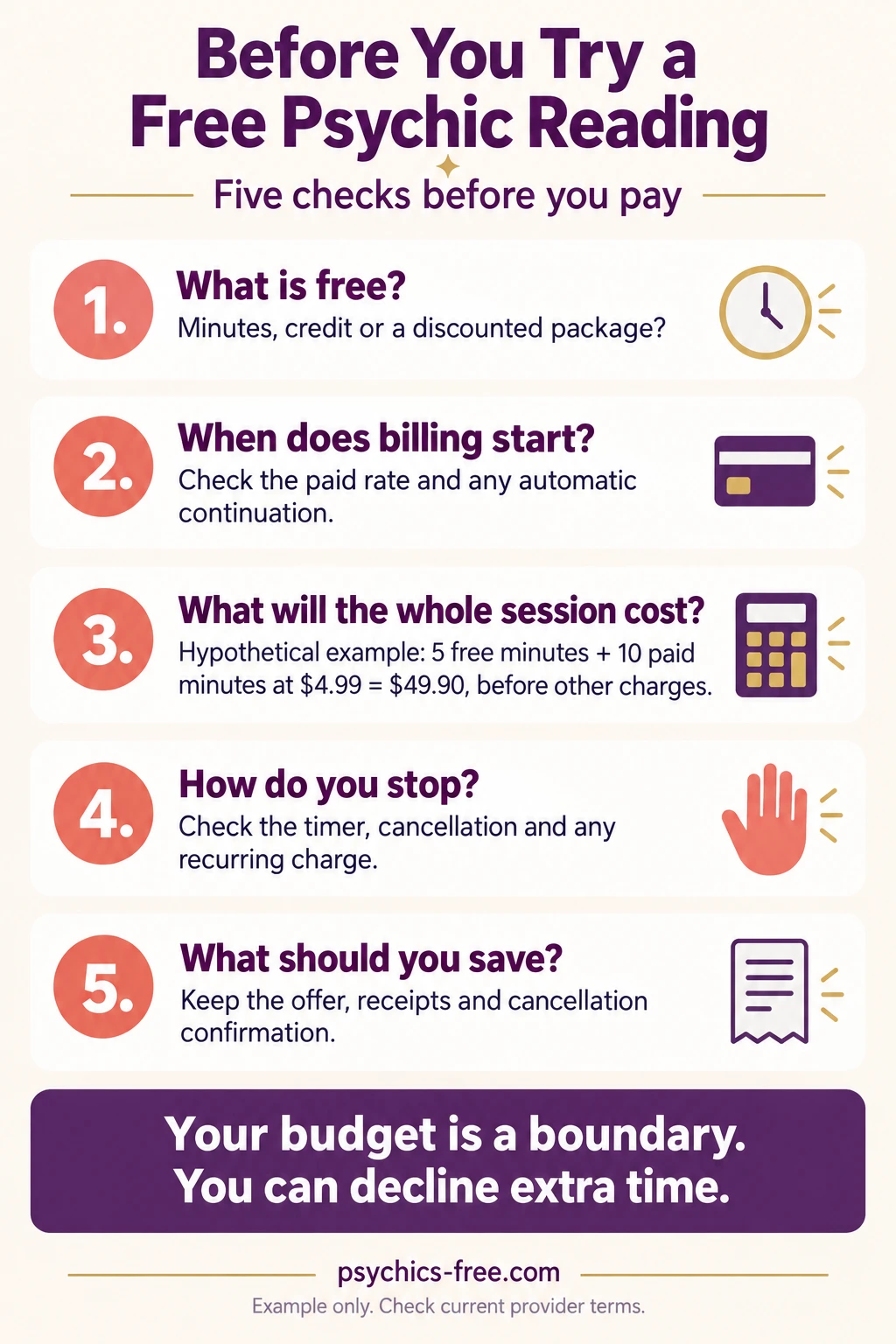
Read the infographic as text
- What is free: minutes, credit or a discounted package?
- When does billing start: check the paid rate and automatic continuation.
- What will the session cost: a hypothetical five free minutes plus ten at $4.99 costs $49.90 before other charges.
- How do you stop: check the timer, cancellation and recurring charges.
- What should you save: keep the offer, receipts and cancellation confirmation.
Your budget is a boundary. You can decline extra time. Check current provider terms.
Translate the headline into a transaction
“Free minutes” may apply only to a first account, selected readers or one communication format. “Free credit” may require a purchase. “Introductory package” may simply mean a lower prepaid price. These are different arrangements.
Before signing up, check whether unused credit expires, whether paid time begins automatically, whether an account balance reloads and whether a separate membership renews. Ending a call does not necessarily cancel a subscription.
The FTC’s free-trial guidance recommends understanding the trial period, cancellation process and later charges before enrolling. Keep a copy of the offer and monitor statements afterward. This is general consumer guidance; specific rights and procedures depend on location and payment method.
Calculate the whole session, not the headline price
For a simple per-minute offer, the estimate is: paid minutes multiplied by the regular rate, plus any separately disclosed charges. Check rounding rules, minimum charges, taxes and currency conversion before relying on that estimate.
Example A: stop at five minutes
Five genuinely free minutes, no other fees, and disconnection before paid time: $0.
Example B: continue to fifteen
Five free minutes, then ten at $4.99: $49.90 before other charges.
Example C: fixed package
A hypothetical twelve-minute package for $18: $18 if no extras apply. Unused minutes may have no refund value.
These examples do not establish a normal market price. Their purpose is to show why the same offer can be inexpensive for a short introduction and costly for a longer conversation.
Understand the billing clock
Ask whether introductions, verification, hold time or reconnecting count as billable time. Find out whether the timer displays elapsed minutes, remaining credit or estimated cost. If a platform uses tokens, translate them into the currency you actually pay.
Set a reminder shortly before your limit and a firm endpoint. You can say, “Please summarize before my prepaid time ends. I do not want extra paid time.” But do not rely on a verbal request alone: understand the platform’s controls and disconnect before the limit if necessary.
A conversation can feel unfinished when the promotion ends. That feeling does not create an obligation to continue. You can return to your question privately without buying an answer immediately.
Distinguish an optional upgrade from pressure
An optional recording or written report offered at a clear price before the session is different from an expensive “cleansing” proposed after a frightening claim. Ask whether you would still want the extra service without the fear attached to it.
Do not pay because someone says a curse, soulmate emergency or closing spiritual window requires immediate action. The FTC identifies urgency and demands for particular payment methods as common scam warning signs. Stop and seek an independent perspective before sending more money.
A reader should accept “no” without threats, guilt or repeated attempts to sell. A claim that only the reader can protect you is a reason to disengage, not a reason to authorize another charge.
Evaluate the reader and the platform separately
For the reader, consider listening, relevance, honesty about uncertainty and respect for boundaries. For the platform, consider pricing, timer controls, privacy, cancellation and customer support. A kind conversation does not excuse a billing problem; clear billing does not establish psychic accuracy.
For a different angle, our free online tarot platform guide distinguishes automated tools and promotional readings. If examining a particular service, our PsychicOz pricing review provides service-specific context; always recheck the provider’s current checkout terms.
Keep a simple billing record
- The offer, date, currency and eligibility conditions.
- The regular rate, expiration date and any reload or renewal settings.
- Appointment start and end times, receipts and balance changes.
- Written support messages and cancellation confirmation.
If a charge is unexpected, compare it with the terms you saved. Contact the company through a verified channel and state what you agreed to, what was charged and the remedy you are requesting. For an unauthorized or unresolved charge, contact your payment provider promptly about its dispute procedure. Recovery is not guaranteed.
Do not assume deleting an app or avoiding an account ends a membership. Follow the stated cancellation procedure, save confirmation and watch subsequent statements.
Key Takeaways
- “Free” describes only part of some offers.
- Calculate the cost for the duration you actually want.
- Check call continuation, balance reload and membership renewal separately.
- Optional extras must remain optional.
- Your spending limit matters even when the conversation feels meaningful.
15 frequently asked questions
1. Are free psychic readings always completely free?
No. An offer may cover only introductory minutes or require another purchase. Read the full conditions before entering payment information.
2. Why does a free trial ask for a card?
The service may use it for verification or later billing. Ask exactly which charges you are authorizing and when they can occur.
3. What happens when free minutes end?
Depending on the platform, the session may stop or continue at a paid rate. Confirm the rule before starting.
4. How do I calculate a per-minute reading cost?
Multiply paid minutes by the stated rate and add disclosed charges. Check minimums, rounding, tax and currency conversion separately.
5. Are the prices in this guide current offers?
No. They are hypothetical examples showing how billing arithmetic works, not verified provider prices.
6. Can credits expire?
They can if the offer terms provide for expiration. Check the deadline and whether unused credit is refundable.
7. Is ending a call the same as cancelling a membership?
Not necessarily. Session billing, automatic reload and subscription renewal may have separate settings and cancellation steps.
8. Should I tell the reader my budget?
Yes, but also use the platform's controls and a timer. A spoken request alone may not stop automatic billing.
9. Are all upsells scams?
No. Clearly priced optional extras can be ordinary sales. Threats, fear and pressure to buy urgently are serious warning signs.
10. What if I am told I need an urgent cleansing?
Do not treat a frightening claim as proof of danger. Stop the purchase and discuss the situation with someone independent whom you trust.
11. Can I get a refund for an unsatisfying reading?
That depends on the policy and applicable rights. Read the conditions before paying; dissatisfaction alone does not guarantee reimbursement.
12. What records should I keep?
Save the offer, terms, receipts, session times, support messages and cancellation confirmation. Avoid sharing sensitive payment details publicly.
13. What should I do about an unauthorized charge?
Contact the company through a verified channel and promptly ask your payment provider about its dispute process. Keep supporting records.
14. Is a bigger package always better value?
No. A lower advertised per-minute price may still cost more if you use only a small part of the package or credits expire.
15. Does a clear offer mean predictions are accurate?
No. Transparent billing is a consumer-service standard, not evidence that psychic predictions are reliable.