

Updated
You do not need a paid reading to reflect on a dream. A few lines on paper can help you describe what you remember and consider why it caught your attention. The worksheet below is free to copy into your own notebook; it does not require an account, special object or dream dictionary.
Use it as a writing exercise, not a test with a correct answer. Its purpose is to make your thoughts clearer, rather than to certify a message from a dream.
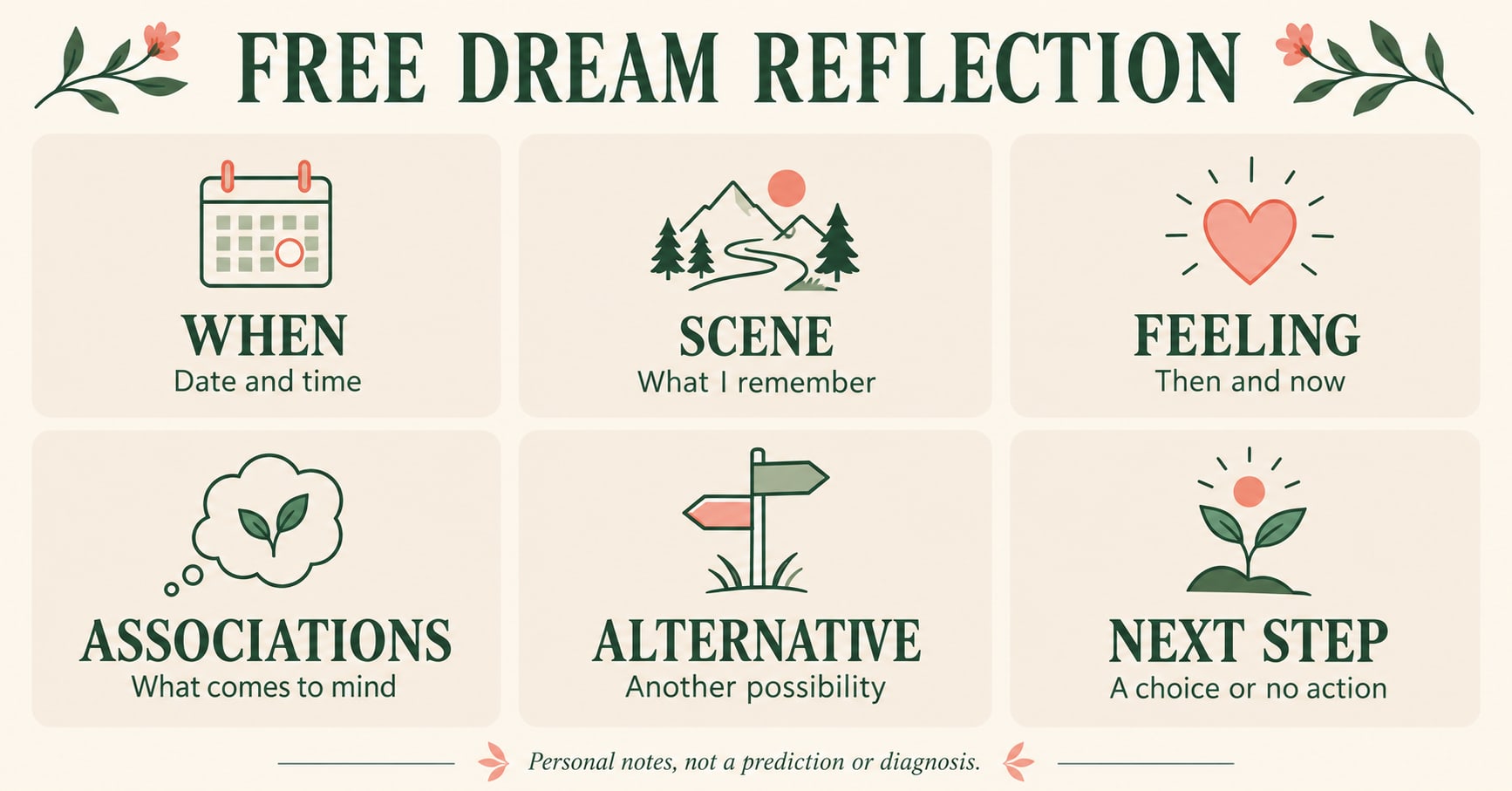
Copy the worksheet
When I wrote this: Date and approximate time.
The part I remember: A scene or fragment, with uncertain details marked.
How it felt: My feeling in the dream and my feeling now.
My own associations: Recent experiences, memories or ideas it brings to mind.
Another possible reading: A different explanation, or “I do not know.”
One reasonable next step: A small action, further reflection or no action.
See how one ordinary example works
Imagine remembering a dream in which you cannot find a borrowed book. Your first association is a real promise you have been meaning to keep. Another possibility is simply that you visited a library recently. Both belong in the note; neither needs to become the official meaning of the dream.
A proportionate next step could be checking whether you still owe someone a book or a reply. You already have a waking reason to do that. The dream does not prove that the person is angry with you.
Leave room for incomplete answers
You may remember only a color or feeling. Write that instead of extending it into a detailed story. If no personal association comes to mind, leave the space blank. “Unknown” is a useful answer when the alternative is forcing a meaning.
Likewise, you can enjoy a pleasant dream without turning it into homework. The worksheet should fit around rest and daily life. There is no requirement to interrupt sleep, record every night or finish every box.
Keep the exercise genuinely free of pressure
If you later share the note with a reader, decide in advance what you are comfortable disclosing and spending. You can decline a suggested interpretation. An alarming claim about a curse or an urgent payment does not become credible because it refers to a detail you supplied.
For help deciding which kind of support fits a concern, read our guide to psychic readings and qualified therapy. Check the role and qualifications of the person you consult rather than assuming the services are interchangeable.
Close the notebook when it has served its purpose
After writing, ask whether you have a clearer question or a sensible next step. If not, you can leave the dream unresolved. Repeatedly searching for an interpretation is not a condition of understanding yourself.
Regular nightmares that disrupt sleep or everyday life are a reason to seek medical advice, as explained in the NHS guidance on nightmares. A worksheet is not treatment.
The suggestion to keep a dream journal and create a personal dream dictionary is practical. It encourages a systematic approach to dream interpretation, which could be very beneficial for those serious about understanding their dreams.
The article’s emphasis on the personal nature of dream interpretation is quite insightful. It acknowledges the unique symbolism that each individual possesses, which is crucial for accurate self-reflection.
The article’s notion that dreams can contribute to overall health and happiness is compelling. It underscores the potential positive impact of paying attention to and understanding our dreams, beyond mere curiosity.
I appreciate the article’s point that dreams can have multiple levels of meaning. This acknowledges the complexity of dreams and the various influences, such as somatic conditions, that can impact them.
It’s interesting how the article highlights dreams as a source of knowledge and self-understanding. The idea that dreams might reveal our true feelings about important life issues is particularly thought-provoking.