

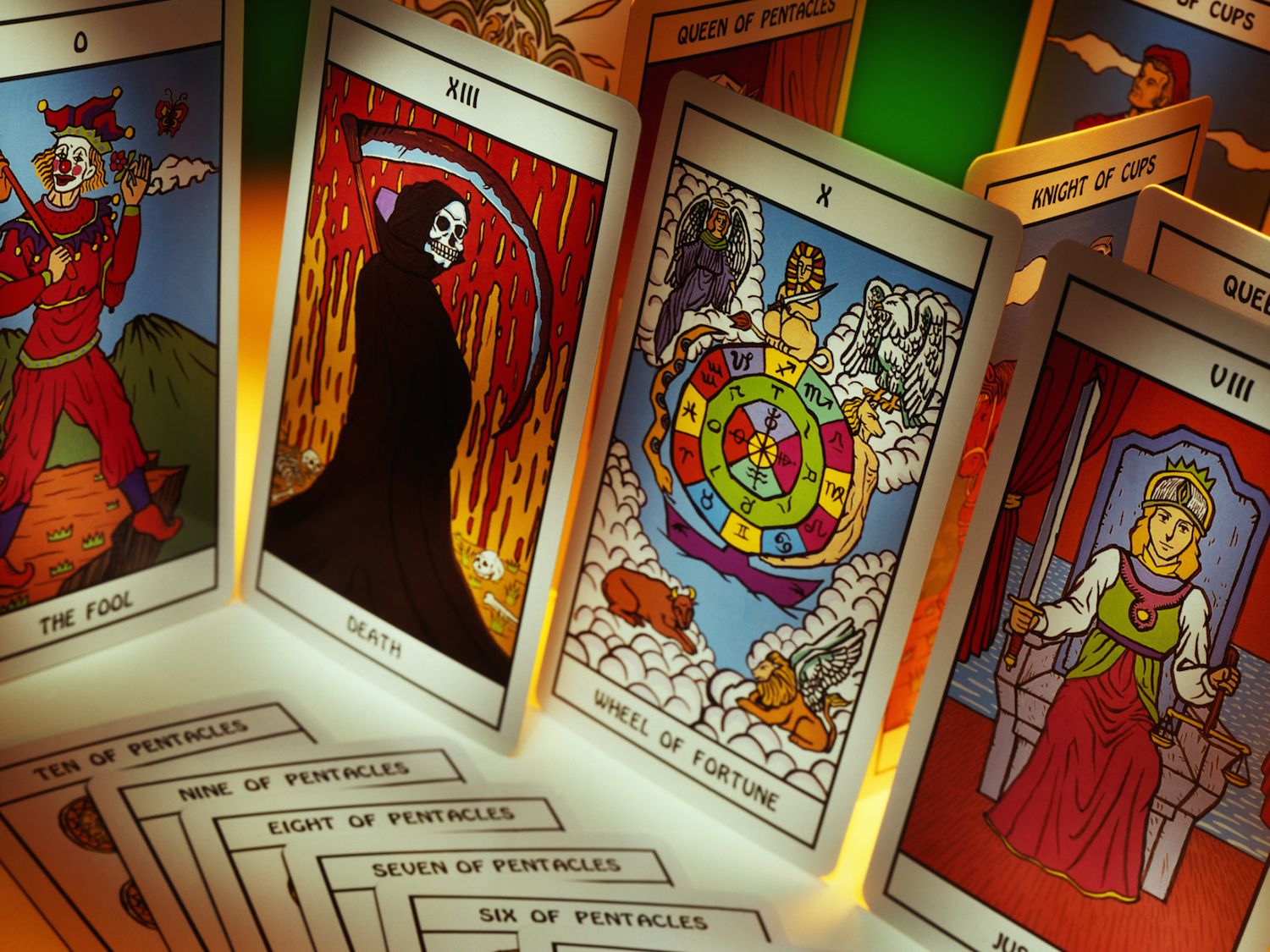
Tarot images can offer prompts for reflection, storytelling or spiritual practice. Reading them does not establish what another person thinks or guarantee what will happen. You can learn with a guidebook and your own observations; memorizing every meaning first is unnecessary.
Start with Your Deck’s Structure
In the familiar Rider–Waite–Smith tradition, a standard deck has 78 cards: 22 Major Arcana and 56 Minor Arcana. The deck publisher describes that structure. Other decks may change names, imagery or numbering, so check the guide included with yours.
The Fool’s journey is one interpretive way to connect the Major Arcana, not a rule proving that every life follows the same story. A card can suggest a theme without announcing an unavoidable event.
Use Suit Meanings as a Starting Point
In a common modern interpretation, Wands relate to fire and initiative; Cups to water and feelings; Swords to air and thinking or conflict; and Pentacles to earth and practical matters. These are conventions, not universal meanings across all traditions.
Compare the guidebook with the actual image. A financial or bodily theme on a card is not investment advice or a medical diagnosis. For more on these associations, see the four tarot elements.
Ask a Question You Can Reflect On
Try “What should I consider before this conversation?” or “What information am I missing about this choice?” These questions leave room for your judgment and real-world evidence.
Avoid using a reading to decide whether someone has consented, whether a symptom is harmless or whether a major purchase is safe. Those questions require appropriate information beyond cards.
Try a Small Spread
- Write down one question and choose a simple layout before drawing, such as situation, consideration and possible next step.
- Shuffle in a way comfortable for you. Stop when you choose; an energy shift is not required.
- Draw the cards and describe what you see before consulting meanings: figures, setting, movement and contrasts.
- Read the deck’s guidance, then note more than one possible interpretation. Distinguish what the card shows from what you are assuming.
- Choose one practical action to investigate, not a prediction to obey.
Keep a Brief Record
Note the question, cards and your interpretation. Later, ask whether the reflection was useful and whether you overlooked ordinary explanations. Do not rewrite every outcome to make a prediction appear correct.
Practice when you enjoy it, not because you must draw every day. If repeated readings leave you more worried or searching for reassurance, take a break. You remain free to disagree with a reading and make your own decisions.
The recommendation for specific tarot decks like the Hanson-Roberts deck adds a touch of personalization to the article. It’s helpful for readers looking to start with a reliable deck that offers clear illustrations.
It’s interesting how the article describes the journey of life as a spiral rather than linear. This metaphor resonates well with the cyclical nature of major life events.
The detailed explanations of the four tarot suits and their corresponding elements are quite illuminating. It provides a solid foundation for understanding how each suit influences a reading.
Indeed, it’s a helpful guide for both newcomers and experienced readers to deepen their comprehension of tarot.
I agree, Sharon. The breakdown of the suits’ meanings helps in demystifying the process of tarot reading.
The analogy of reading tarot cards to interpreting an illustrated storybook is quite effective. It simplifies the concept for those who might find the idea of tarot reading intimidating.
The practical tips for giving yourself a tarot reading, such as shuffling the cards while thinking about a question, are quite useful. It emphasizes the role of intuition in the reading process.