

Historical article: This page looks back at January 2018. It is not a schedule for the current year or an announcement of an upcoming eclipse.
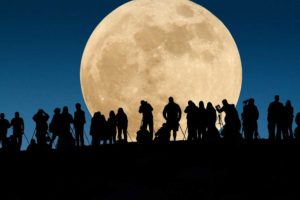
The start of 2018 offered notable lunar views. NASA’s contemporary guide identified a sequence on December 3, 2017, January 1, 2018 and January 31, 2018.
What Is a Supermoon?
A full supermoon occurs when the full Moon is at or near its closest approach to Earth, called perigee. The orbit is elliptical, so its distance varies. NASA explains supermoons and their apparent size and brightness.
It is not defined by being “within 90 degrees” of closest approach. Popular definitions and thresholds can vary, so a claimed yearly count needs the definition used.
The January 31, 2018 Eclipse
January 31 combined a supermoon with a total lunar eclipse. It was also described as a blue Moon because it was the second full Moon in that calendar month in the relevant time zones.
NASA’s 2018 explanation discusses the combination and where the eclipse could be seen. Visibility depended on location; it was not the same spectacle everywhere.
Why an Eclipsed Moon Can Look Red
During a lunar eclipse, Earth lies between the Sun and Moon. Sunlight filtered through Earth’s atmosphere can give the Moon a reddish appearance. The nickname “blood Moon” does not establish a supernatural danger or prediction.
Names and Astrological Meanings
Names such as Wolf Moon are cultural labels, not astronomical causes. Do not assign one naming tradition to all Indigenous peoples or infer that wolves howl at the Moon because of the name.
Astrological interpretations of a full Moon are a separate belief framework. A horoscope cannot establish that this event caused clairvoyance, improved relationships or guaranteed creative insight.
For Future Moon-Watching
Use a current astronomy calendar and information for your location. Do not reuse the dates or viewing times from a 2018 article.
You can enjoy a lunar event for its appearance, scientific interest or personal symbolism without treating it as a message requiring a major decision.
Understanding the difference between a Supermoon and a regular full moon is made clear in this article. It’s interesting to note that we will experience multiple Supermoons in 2018, and that the moon’s distance from Earth is gradually increasing. These insights provide a fascinating perspective on celestial mechanics.
I found the historical context around naming the moons quite fascinating. The connection between the moons and the seasons, as well as the cultural differences in naming, adds a rich layer of tradition to the astronomical observations. The association of the Wolf Moon with wolves’ mating season was particularly intriguing.
The article provides a thorough explanation of the Wolf Moon and its significance, especially highlighting the interesting astrological connections. The idea of wolves howling more during their breeding season aligns perfectly with the timing of the Wolf Moon. I also appreciate the detailed distinction between Supermoons and regular full moons.
The astrological connections outlined in the article, particularly the full moon’s alignment with planets in other water signs, offer a compelling narrative for those interested in astrology. The term ‘Supermoon’ and its scientific background, including its origin and distinction from ‘perigee moons’, was explained clearly and informatively.
The article captures the essence of the first Full Moon of 2018— the Wolf Moon— with both scientific and cultural perspectives. The explanation of wolves’ behavior in relation to the moon phases adds depth to the discussion. Additionally, the visualization of the Supermoon as something almost within reach is quite vivid and engaging.